
The future of clean energy will not be built only by generating more renewable electricity. It will also depend on how intelligently we store that energy, how responsibly we use natural resources, and how effectively we turn today's industrial by-products into tomorrow's high-value materials.
At NexIB Technologies, we believe that sustainability starts at the material level.
One of the biggest challenges in the battery industry is the supply chain behind battery materials. Many existing battery technologies depend on critical raw materials, complex global supply routes, and energy-intensive processing methods. As global demand for energy storage grows, the question is no longer only: "Can we make better batteries?"
Can we make better batteries from smarter, more sustainable materials?
This is where chemical thermodynamics becomes powerful.
Chemical thermodynamics helps us understand how materials behave under different temperatures, pressures, and reaction conditions. It allows us to predict whether a transformation is possible, how much energy it requires, and how the structure of a material can be controlled during processing.
In simple terms, thermodynamics gives us a scientific roadmap for turning carbon-rich waste or underutilised feedstocks into advanced battery materials.
For next-generation sodium-ion batteries, hard carbon is one of the most important anode materials. Unlike lithium-ion batteries, sodium-ion batteries do not rely as heavily on scarce resources such as lithium, cobalt, or nickel. This makes them highly attractive for large-scale energy storage, grid applications, and more affordable battery systems.
However, the success of sodium-ion batteries depends heavily on the quality, consistency, and sustainability of hard carbon materials.
That is the opportunity NexIB is working on.
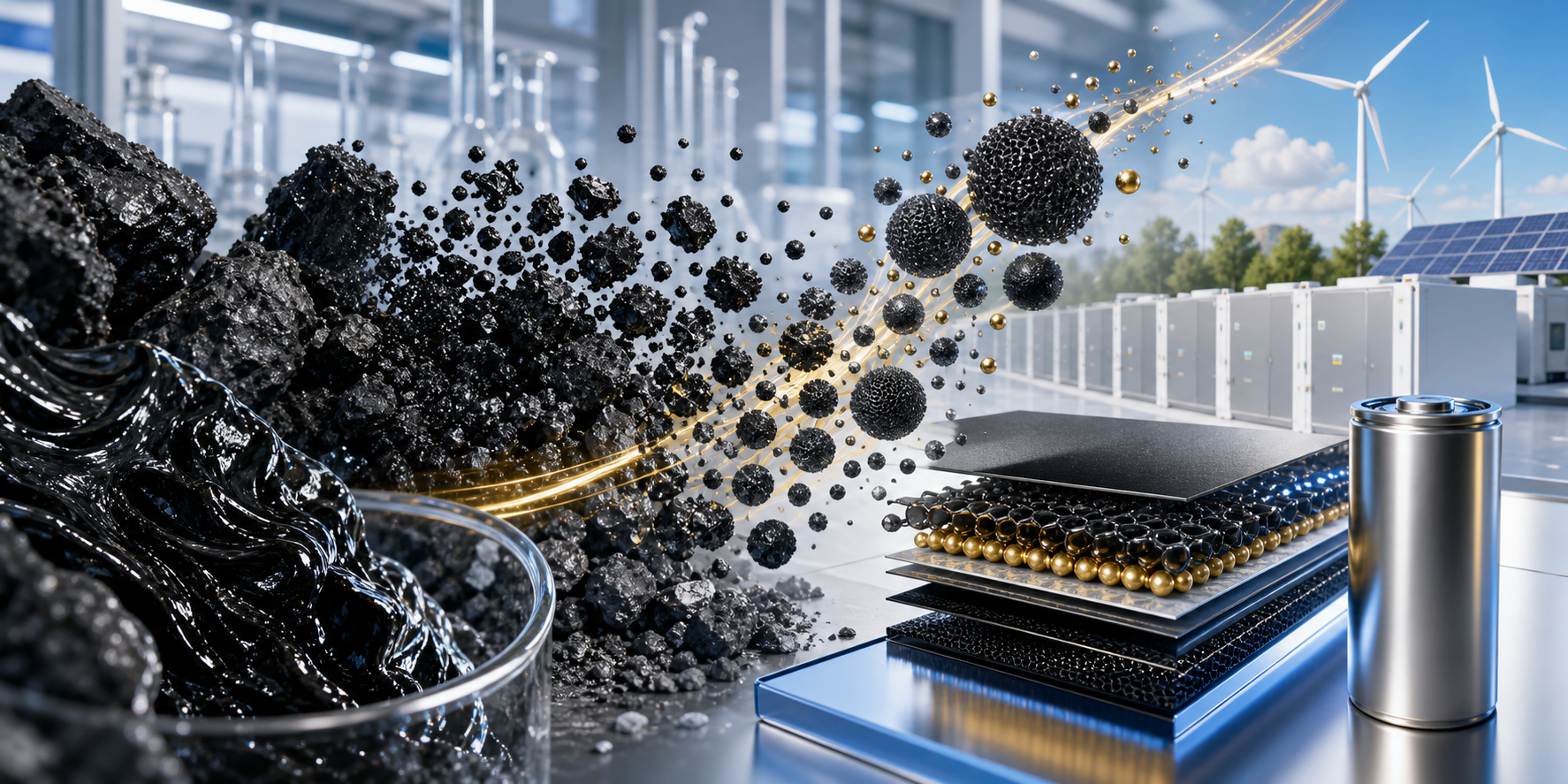
We are exploring how asphaltene-derived carbon sources can be transformed into engineered hard carbon anode materials. Asphaltenes are carbon-rich components often treated as low-value or problematic by-products in hydrocarbon processing. But with the right scientific approach, they can become a valuable precursor for clean-energy materials.
From waste-like carbon streams to high-performance battery materials.
Through controlled thermal treatment, carbonisation, and material engineering, chemical thermodynamics can help guide the conversion of complex carbon structures into stable, functional hard carbon. By understanding energy changes, phase behaviour, molecular stability, and reaction pathways, we can design better processing routes and reduce unnecessary trial-and-error in material development.
This matters because sustainable innovation is not only about the final product. It is also about the process.
A truly sustainable battery material should aim to:
- Reduce dependence on critical raw materials
- Use available or underutilised feedstocks
- Support lower-emission production routes
- Enable scalable manufacturing
- Deliver reliable electrochemical performance
- Strengthen local and regional supply chains
For the UK and Europe, this is especially important. The clean-energy transition requires not only renewable power, but also resilient battery supply chains. Developing local material innovation can reduce dependency on overseas supply routes and support a stronger domestic battery ecosystem.
Sodium-ion batteries are particularly promising in this context. Sodium is more abundant than lithium, and sodium-ion systems have strong potential for stationary storage, renewable energy balancing, industrial backup power, and cost-sensitive applications.
But the material challenge remains clear: we need better hard carbon.
At NexIB Technologies, our sustainability vision is built around the idea that advanced materials can be created from overlooked resources. By combining chemical thermodynamics, carbon materials science, and battery engineering, we aim to create a new pathway for sodium-ion battery materials.
This is not just a technical challenge. It is a sustainability challenge.
The next generation of batteries must be cleaner, safer, more affordable, and more scalable. To achieve that, we need to rethink the entire value chain, from raw material selection to processing, performance validation, and commercial scale-up.
The future of energy storage will belong to companies that can connect science with sustainability.
At NexIB Technologies, we are working toward that future by transforming carbon-rich feedstocks into advanced hard carbon materials for sodium-ion batteries.
Because clean energy should not only come from the power we generate. It should also come from the materials we choose.